
Your needs, this model
Does it fit your priorities?
Can your planned location provide the 120’s cold-water, drain and GFCI connections?
The manual-era setup requires a cold-water line, a toilet or laundry drain route, and a GFCI outlet. If those cannot be provided, the 120’s documented operating plan does not fit.
Explore this need in the finder →Are you willing to use CatGenie Washable Granules rather than ordinary litter?
The 120 instructions say to use its Washable Granules only and warn that ordinary litter can clog or damage the system. Do not use a current CatGenie model’s supplies without checking compatibility.
Explore this need in the finder →Is an approximate 38-minute manual-era cycle acceptable rather than a strict modern maximum?
The setup guide estimates about 38 minutes for a full cycle, while current consumable and service status for this historical unit are not confirmed. An exact or strict maximum time should not be inferred from that old estimate.
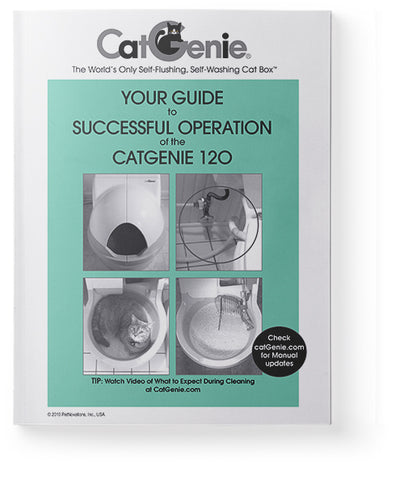
Explore this need in the finder →The CatGenie 120 is a manual-era U.S. version of CatGenie’s plumbed, self-washing litter appliance, not a conventional rake box or rotating globe. Its 2010 owner’s guide identifies the model as “CatGenie 12O” and prints UPC 891329001256. This page is useful for identifying or operating that documented generation; it is a historical reference, not a current purchase recommendation. The old manual is unusually important here because the 120’s litter, cartridge, controls and setup should not be assumed interchangeable with today’s CatGenie A.I. or Whoosh.
Start with the water-and-drain installation
The 120’s open bowl is part of a fixed appliance installation. The manufacturer’s setup guide calls for a cold-water connection, a route for the waste hose to a toilet or laundry drain, and a GFCI wall outlet. It specifies an eight-foot supply hose and a ten-foot drain hose, and warns against an extension cord. Measure the actual route and leave room to reach the controls and service the processing unit; a bathroom-looking footprint is not enough if the water and waste lines cannot be routed correctly. Hot water is explicitly prohibited in the setup guide.
This is not a useful choice for a spare bedroom or rental where a permanent plumbing connection is impractical. Unlike a drawer-based automatic box, it sends wastewater through plumbing rather than storing clumps in a bag. That can reduce daily scooping, but it ties the box to a suitable drain and gives the owner more plumbing and clog points to monitor. Follow the 120 guide for toilet or laundry installation instead of adapting instructions from a newer model.
Its washable granules and cartridge are model-specific
The CatGenieHand scoops solid waste into the hopper; the unit washes the reusable, non-absorbent granules, drains wastewater and blows warm air through the granules to dry them. CatGenie’s 120 instructions say to use CatGenie Washable Granules only and never mix in ordinary litter: even a small amount of clumping litter can clog the system or damage its water sensor. The granules remain in the bowl but may need topping up if they are lost. A CatGenie 120 SaniSolution cartridge is also required for the appliance to run. The manual identifies a translucent silver 120 cartridge and specifically warns not to use a cartridge with brass bars. Do not infer compatibility from a current package photo or another CatGenie generation.
Control is on the appliance. The 2010 owner’s guide describes manual push-start, a timed Auto Start schedule of one to four cycles a day, and Cat Activation, which waits until ten minutes after the cat leaves and restarts that wait if another cat enters. In Auto Start and manual operation, it assigns 120 SaniSolution portions to a cartridge; Cat Activation changes the counter to 240. The separate 120 acclimation guide instead uses the term “Time Activation” for a user-set delay. The exact firmware/manual pairing is not established, so use the guide supplied for the individual unit rather than combining the two control descriptions. The setup guide gives a total cycle time of about 38 minutes, not a guaranteed time for every aged unit. Keep another acceptable litter location available while a long wash-and-dry cycle runs.
Do not treat the schedule chart as a capacity rating
Cat count depends on the operating advice being followed. The separate 120 acclimation guide says a single unit may serve up to three cats only when Cat Activation runs after use; if using its Time Activation or Manual modes, it recommends one unit for every two cats. The 2010 owner’s guide separately advises one to two cycles per day per cat and prints schedules for one, two and three cats, although its Auto Start control is described as one to four scheduled cycles a day. That is not a clean universal capacity rating, so keep the manual-generation and mode distinction visible. No minimum cat weight is specified in the sources reviewed. The acclimation guide also recommends a gradual transition and manual cycles while a cat gets used to the sounds and movement; its success claims are the manufacturer’s advice, not a promise for an individual cat.
Expect hands-on care. The manual’s troubleshooting and maintenance sections call for keeping the hopper clear of hair and foreign objects, checking the sensor, keeping hoses unkinked, and cleaning the unit when clogs or mineral deposits occur. The official documents are from 2010; they provide model-specific operating instructions but do not establish what service, cartridge or replacement-part support is available now. An old warranty statement is not evidence of coverage for a used unit today.
Who should keep this manual, and what should a new buyer compare?
The CatGenie 120 is most useful as an identification and operating reference for someone who already has the exact unit, original controls and model-compatible supplies. Before relying on a second-hand appliance, verify its identity from the label, inspect the hoses and processing parts, and confirm that the correct consumables and service route are available; this research does not certify any used unit’s condition. If you want a current CatGenie with washable granules, the CatGenie A.I. review is the closer current comparison, but its instructions and offer terms belong to that later model. The Whoosh review covers a different soluble-litter and shorter-cycle system, so it is not a drop-in cartridge or granule substitute.
If your priority is ordinary clumping litter, easy placement, or avoiding plumbing, compare a self-cleaning unit that retains waste in a removable drawer instead. A requirement for current app reporting, a precise cat-count limit, or a strict maximum cleaning time should not be marked satisfied by the 120: those capabilities are either not documented for this manual-era model or the machine’s old approximate cycle is not a dependable modern bound. The 120 is a distinctive design, but its age and specialized setup make exact identity and consumable compatibility more important than broad family resemblance. For a three-model comparison, see the CatGenie guide.
Key details at a glance
| Cleaning mechanism | Plumbed self-washing / flushing litter system |
|---|---|
| Default cleaning delay | 10 min |
| Entry and installation style | Open-bowl plumbed wash/flush system |
| Required litter system | Reusable washable granules |
| Waste route | Plumbed drain |
| Requires water and drain plumbing | Yes |
Use the exact model’s instructions for operating limits, supplied equipment and version differences.
Sources for this assessment
- Official CatGenie older-manual index listing the CatGenie 120 documents
- CatGenie 120 Owner’s Guide, copyright 2010; UPC 891329001256
- CatGenie 120 Setup Guide
- CatGenie 120 Acclimation Guide
- Official CatGenie 120 Operation Manual cover image
- Official CatGenie Shop CatGenie collection HTML
- Official CatGenie current Shop collection product JSON (19 product records, 29 exact option SKUs in the captured U.S. list)

Compare the requirements that matter.
Compare cat fit, entry shape, litter, drawer routine, app reporting and exact package contents.