
Your needs, this model
Does it fit your priorities?
Does OpenSky suit an open-top globe and app requirement, rather than an open tray?
Yes. The ZAL00-18120 has an open-top rotating chamber, app connectivity and a sifter.
Explore this need in the finder →Does OpenSky meet a 33-pound upper guide, but not a 33.5-pound requirement?
The product page lists cats up to 33 lb.
Explore this need in the finder →Does an OpenSky kitten need both the age and weight minimum before automatic cycles?
Yes. The manual says at least three pounds and six months; either unmet boundary rules it out.
Explore this need in the finder →Open-top access, rotating sifting and app records
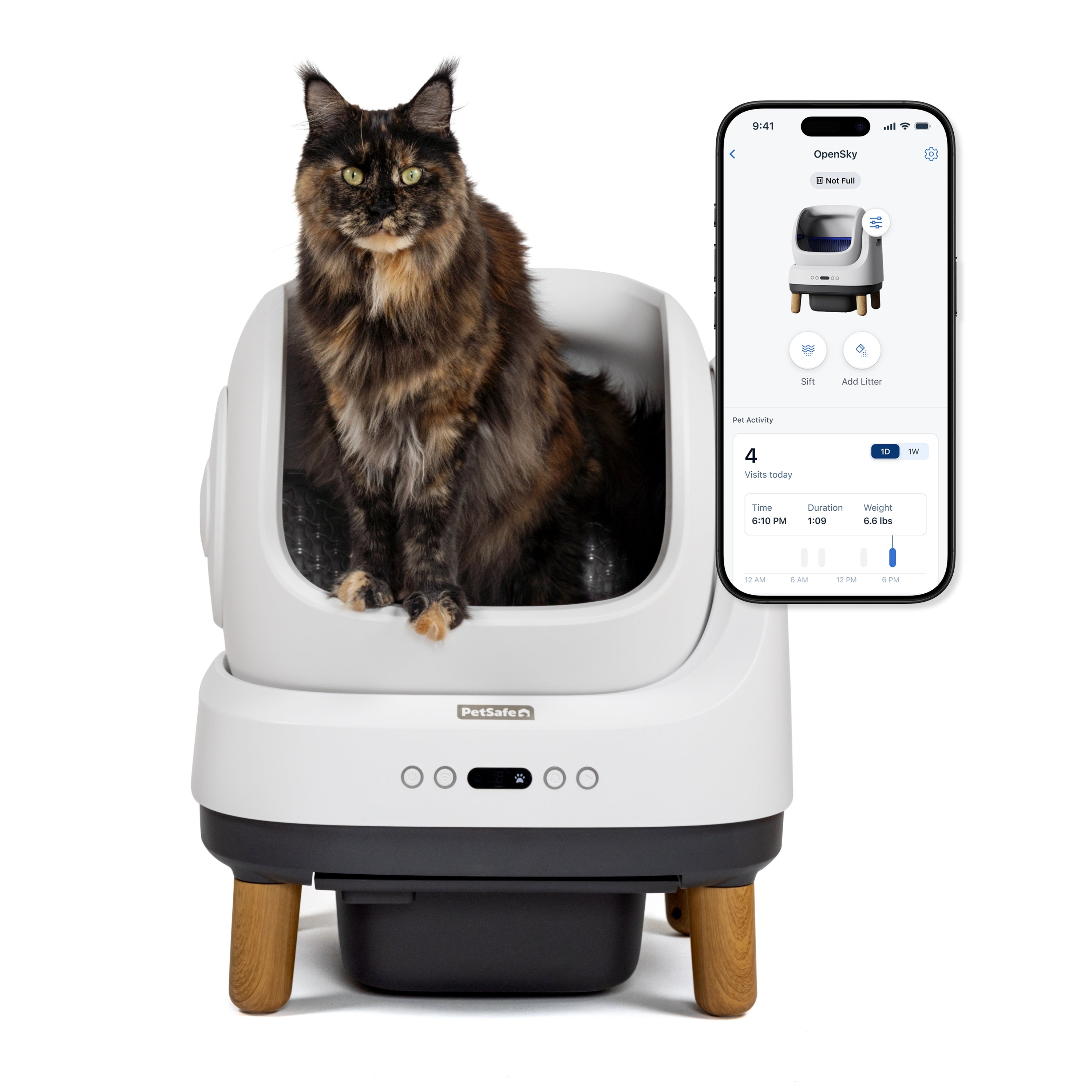
The ScoopFree OpenSky is not an open rake pan. It uses a rotating litter chamber and sifter, but leaves the top of that chamber open rather than asking a cat to enter an enclosed globe. When a cat exits, the box waits through a countdown, rotates the chamber back and separates reusable litter from clumps; waste falls into a drawer below. This gives OpenSky a distinct fit: a household that wants the litter sifting of a rotary system and app-based activity information, but wants an open top instead of SmartSpin’s enclosed sphere.
Its exact US model number is ZAL00-18120. PetSafe’s product page lists app monitoring over 2.4 GHz Wi-Fi, an 8.5-liter waste drawer, a manufacturer upper-weight guide of 33 pounds and compatibility with most clumping litter. The page does not provide a numeric number-of-cats limit, so do not translate “multi-cat” language into a count. The manual sets the automatic-mode sensor threshold at a weight change greater than three pounds and says kittens should stay in manual operation until at least three pounds and six months old. Both age and weight matter.
Open is a shape preference, not a low-sided guarantee
The open upper chamber may be easier to inspect and may feel less tunnel-like to a cat reluctant to enter a covered globe. It still has raised sides, legs, a rotating chamber and moving parts. It is not equivalent to a simple shallow tray, and an open top does not make every cat comfortable with the cleaning movement. PetSafe’s marketing artwork shows a cat at the opening, but that is not evidence that a particular cat will accept the box. Start with a gradual transition and supervise the first cycles.
Before setup, install the legs, put a bag in the waste drawer, set the deodorizer and place the unit on a clean, dry level location near an outlet. Add litter only to the fill line and use the weight-reset control so the device calibrates to the new litter load. The manual warns against larger pine or tofu pellets, which may not pass correctly; “most clumping” is the more prudent reading than “any litter.” A fine clumping litter is the safe first choice. If your cat must keep a non-clumping texture, check with PetSafe before treating it as compatible.
Delay, re-entry and a real maintenance schedule
The manual sets a seven-minute default cleaning countdown after a cat leaves; the app can adjust it. If the cat comes back during the delay, the timer stops and restarts after the next exit. In a cycle, the chamber rotates back, clean litter passes through the sifter and redistributes, while clumps and waste are directed to the drawer. The sifter cover has a special role during a full litter-emptying cycle: follow the manual’s instructions and reinstall it before emptying so all of the litter goes into the drawer. This detail is easy to overlook if you use the ordinary sift command as a shortcut.
The product page says the 8.5-liter drawer holds up to two weeks for one cat. The manual’s schedule is more actionable: expect an empty about every two weeks for one cat, one or two times per week for two cats, and every few days for three or more. The drawer-full light and app alert are reminders rather than a reason to wait when it is visibly full. Refill to the marked line and reset the litter weight after topping up; if you change litter quantity without resetting, the weight sensor may show a false reading or postpone cleaning. A full drawer, litter tracking and wiping the chamber remain part of ownership.
What the app can and cannot say
PetSafe presents weight and visit data in an app dashboard, with the ability to adjust the cleaning delay and receive drawer alerts. A history may help you notice an unusual change in a cat’s routine, but the data does not identify an individual animal in a multi-cat household or explain what caused a difference. It is not a diagnosis. The product also depends on compatible 2.4 GHz Wi-Fi for connected features; its automatic cleaning is still controlled by the unit’s sensors and panel if app reporting is not the reason you choose it.
OpenSky’s 33-pound upper guide is more generous than the SmartSpin’s 25-pound figure, but its three-pound sensor threshold is higher than SmartSpin’s two-and-a-half-pound change detection. That does not establish a better fit for every cat. Compare both the cat’s weight and age with the manual, then inspect the real entrance dimensions and the room around the box; PetSafe does not list numeric cat capacity or a full dimension-by-axis fit in the information used here. If the enclosed sphere is acceptable and a lower documented weight threshold matters, consider SmartSpin. If a cat strongly prefers clumping litter and a wide-open tray, the mechanical ScoopFree Clumping is a different option, not an open-top globe.
Who should put OpenSky on the shortlist?
OpenSky makes the most sense when open-top access is specifically appealing, the cat meets the three-pound/six-month automatic-use rule, clumping litter is acceptable, and the family is willing to connect 2.4 GHz Wi-Fi for activity features. The drawer size is a meaningful difference from SmartSpin, but its two-week claim is for one cat; it should not be projected onto a larger household. Pick another design if a confirmed numerical cat-count rating, a lower weight threshold, a conventional shallow pan or a crystal tray is essential. Most importantly, introduce the moving cycle at the cat’s pace and keep a familiar litter option available until acceptance is clear.
Key details at a glance
| Cleaning mechanism | Automatic open-top rotating sifter |
|---|---|
| Minimum cat weight for automatic mode | 3 lb |
| Waste drawer volume | 8.5 L |
| Manufacturer-stated upper cat-weight guide | 33 lb |
| Manufacturer's single-cat drawer interval claim | 14 days |
| Waste-type recognition | No |
| Default cleaning delay | 7 min |
| App-adjustable cleaning delay | Yes |
| Built-in dual-camera system | No |
| Litter-level monitoring | Full-drawer notification only |
| Color LCD screen | No |
| App reporting / remote controls | Yes |
| Litter and care limits | PetSafe says most clumping litter types work. The user guide warns larger pellets such as pine or tofu may not pass correctly; use a clumping texture the sifter can handle. |
| Exact-model and package notes | Exact US model ZAL00-18120. Top-open chamber is not a shallow tray: it rotates to sift litter and deposit waste in the drawer. |
| Local visit counter | No |
| Tray-life indicator | No |
| Wi-Fi band | 2.4 GHz only |
Use the exact model’s instructions for operating limits, supplied equipment and version differences.
Sources for this assessment
Compare the requirements that matter.
Compare cat fit, entry shape, litter, drawer routine, app reporting and exact package contents.