
Your needs, this model
Does it fit your priorities?
Does the label identify the camera-free enclosed C10 rather than C10 PRO or semi-open C41 Pro?
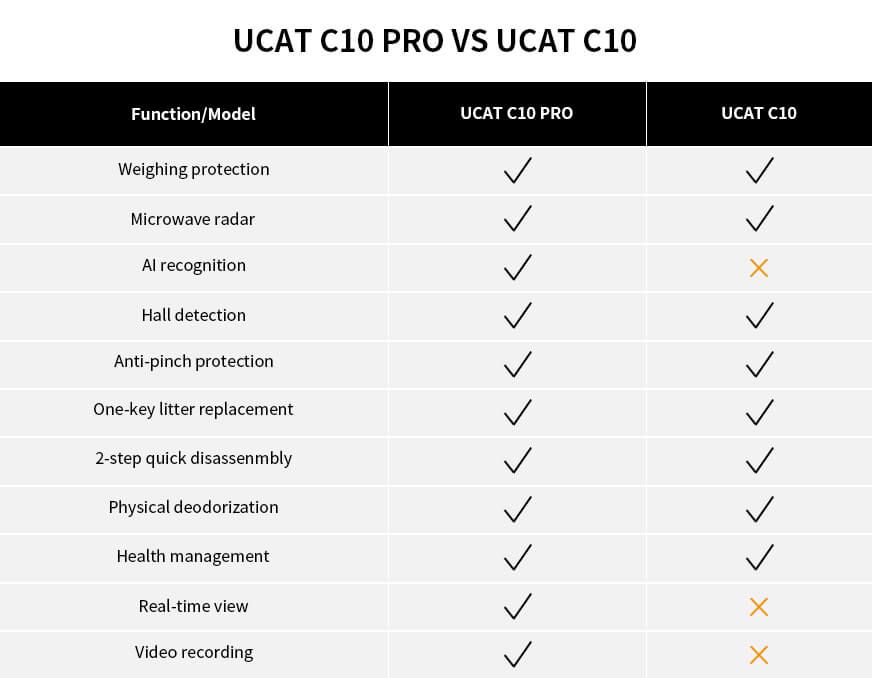
The official product route labels UCAT C10 and its comparison graphic marks camera view, recording, AI recognition and radar as absent on base C10; do not transfer the Pro feature set.
Do the cat and litter meet the shared manual guide?
The manual gives cats at least 3 lb and older than four months, clumping litter under 15 mm, and beads/crystals only when small enough to pass the filter; 44 lb is machine load, not the cat limit.
Is a current U.S. purchase offer established for this exact base model?
Not in this research pass. The exact model remains a useful owner reference and is excluded from buying recommendations until an exact U.S. offer and package SKU are verified.
What the model name does—and does not—mean
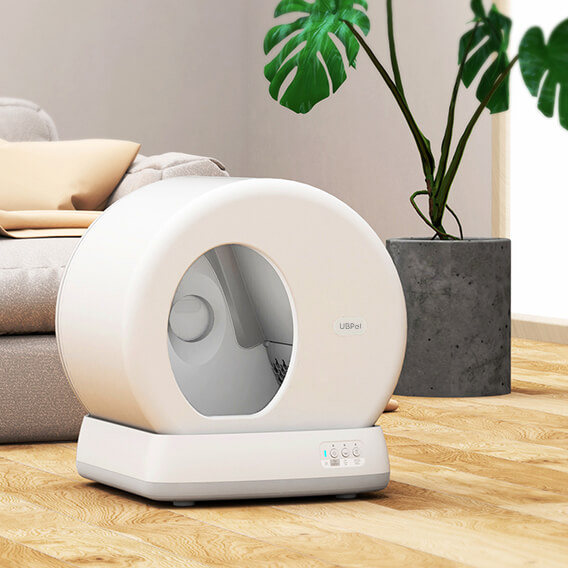
The UBPet UCAT C10 is the camera-free member of the enclosed C10 drum family. The manufacturer portal has a separate C10 product route and image, and its comparison graphic puts UCAT C10 beside UCAT C10 PRO. A manufacturer-issued manual filed with the FCC names both models. These are stronger identity evidence than a marketplace title that simply says “smart cat litter box.” The base C10 is not the camera-equipped C10 PRO, and neither is the later semi-open C41 Pro.
This review keeps the standard C10 as an owner/reference profile rather than a purchase recommendation: the current UBPet U.S. store snapshot did not list it, and this check did not establish an exact current U.S. seller offer or package code for the base model. That is not proof no old, refurbished or third-party unit exists. If you already have one, read the code on its own label and use the manual that came with it. Do not use a C10 PRO listing, parts title or similar-looking picture to identify your unit.
The practical difference from C10 PRO is the camera suite
The manufacturer’s model comparison shows the C10 has weighing protection, drum and rear-cover location detection, anti-pinch protection, one-key litter replacement, quick disassembly and health management. It does not have the Pro’s microwave radar, AI recognition, real-time view or video recording. The manual describes radar protection as an additional Pro function. If you specifically need camera-based observation, recorded video or the maker’s AI-recognition feature, the base model does not meet that need; compare the exact C10 PRO review instead. Do not assume that “health management” means individual identification, veterinary monitoring or a medical diagnosis.
Both models can use device buttons, and the manual also describes app setup on a 2.4 GHz Wi-Fi network with Bluetooth. So the choice is not simply connected versus offline: the base model is still app-enabled, but it lacks the documented C10 PRO camera features. A household whose router is 5 GHz only should not assume either paired-model manual supports app setup on that band.
Check the cat and litter before considering automatic mode
The shared manual gives a cat guide of 3–22 lb and age over four months. It separately lists 44 lb as the machine’s maximum load; that is not a 44 lb cat rating. A kitten below either minimum, an unsteady senior, or a cat that is anxious around moving equipment needs a different arrangement or manual use until the cat is safely eligible and comfortable. Keep a familiar tray available during acclimation; never force a cat into the rotating chamber.
The ordinary material plan is clumping litter shorter than 15 mm. The manual’s safety instructions also allow litter beads or crystals only when they are small enough to pass through the filter. It gives no separate numerical maximum for those crystals, so the 15 mm clumping limit must not be reused as a crystal-grain threshold. If you require a published crystal size limit, or your existing litter is coarse, compatibility is not established here. The product’s broad rotating-drum design is not evidence that every litter texture will sift cleanly.
Measure around the entire unit, not just the doorway
The manual lists an overall size of 520 × 530 × 555 mm and an empty weight of 9.5 kg, but it does not assign width, depth and height to those three dimensions. It also supplies no entry-width or entry-height figure. I would not promise that the box fits a narrow alcove or a mobility-limited cat from those unlabeled numbers. Leave room to reach the front waste bin, lift out the drum, move the unit without dragging it and keep it on a firm, level surface rather than carpet.
The manual specifies a 5 L waste bin and recommends changing its liner every three to five days. That interval is a care routine, not a guaranteed fill time for a particular household. Empty and check it regularly, keep the cover clear, and clean the interior on the manual’s recommended one-to-three-month schedule. Moisture must stay away from the powered base. As with any automatic box, sensor descriptions do not replace watching the cat or responding when the mechanism behaves abnormally.
Who should choose something else?
The C10 is worth identifying when an owner wants to understand a camera-free enclosed drum and its exact safety, litter and size limits. It is not a sound choice for someone shopping for a currently verified C10 base package, a camera, an open entry, a wide low threshold or a numeric household-capacity promise. The official C10 page documents the model, but current U.S. offer and service details were not established in this research pass; this profile is deliberately excluded from buying matches.
For a camera and the associated Pro-only functions, compare UBPet UCAT C10 PRO, while checking its exact UCAT C10 PRO code and current U.S. offer. For a more open rotating chamber, the UBPet C41 and C41 Pro are separate designs with different entry, network and litter documentation. If the cat needs a genuinely open tray, consider a rake system such as the UBPet C31 instead. These are alternatives, not compatible shells or interchangeable manuals. The key decision is whether the particular cat can comfortably use the geometry and whether the exact supplied unit’s instructions cover the litter you intend to keep.
Key details at a glance
| Cleaning mechanism | Automatic rotating-globe sifting |
|---|---|
| Minimum cat weight for automatic mode | 3 lb |
| Waste drawer volume | 5 L |
| Manufacturer-stated upper cat-weight guide | 22 lb |
| Empty unit weight | 20.94 lb |
| App reporting / remote controls | Yes |
| Litter and care limits | Manual limits clumping litter to length <15 mm; beads/crystals are allowed only if small enough to pass through the filter. No numeric crystal-grain limit is published. |
| Published size note | Manual gives 520 × 530 × 555 mm without naming width/depth/height axes; individual footprint and entry dimensions remain unknown. |
| Included individual-cat tracking | No |
| Wi-Fi band | 2.4 GHz only |
| Required litter system | Conventional clumping litter |
| Waste route | Drawer |
Use the exact model’s instructions for operating limits, supplied equipment and version differences.
Sources for this assessment
- UBPet / UBTECH official UCAT C10 product route
- UBPet / UBTECH official product-portal JavaScript with UCAT C10 route and model copy
- Manufacturer-issued FCC-filed Smart Cat Litter Box manual, shared UCAT C10 PRO / C10
- Official UCAT C10 PRO versus UCAT C10 feature graphic
- Official manufacturer UCAT C10 product image
- Current U.S. UBPet all-products collection JSON page one
Compare the requirements that matter.
Compare cat fit, entry shape, litter, drawer routine, app reporting and exact package contents.